
Quality

The importance of quality in nutritional therapy for gluten-related disorders
A diagnosis of a gluten-related disorder (GRD) usually results in a change in diet. The exact treatment recommendation depends on whether the patient has coeliac disease, wheat allergy, gluten/wheat sensitivity or irritable bowel syndrome. Since switching to a gluten-free/wheat-free diet usually has to be done on a long-term or even permanent basis, the quality of the relevant products is an important aspect. At Dr. Schär, quality control therefore begins in the laboratory and continues from sowing and harvesting to delivery.
Research forms the basis for quality
It is a long road before a new gluten-free product reaches the market – especially when the highest standards of quality are required. Ombretta Polenghi, Head of Research and Innovation at Dr. Schär, explains why: "Our responsibility for raw materials begins in the laboratory. For example, we select suitable varieties in collaboration with external research institutes. Aspects such as nutritional profile, rheology, baking behaviour and sensory properties are taken into account. Only when we have defined and fulfilled these parameters do we venture from the laboratory to the field."
Consistent controls ensure the production process
To ensure a gluten-free production process without any contamination, continuous controls are essential. At Dr. Schär, this begins with the cultivation of the raw materials. Over many years, the company has established close partnerships with selected farmers who guarantee full traceability of products from seed to plate and are part of the controlled "filiera" (the Italian word for production chain). Dr. Schär works with reputable international certification bodies and requires the same from its suppliers and contractors.
Alternative raw materials ensure variety of flavours
In the context of a balanced and varied gluten-free diet, millet, buckwheat and oats are becoming increasingly important. In addition to rice and corn, Dr. Schär therefore uses a variety of alternative seeds, grains and pseudograins. Their high nutritional value, special taste and structure allow new products to be developed. Millet, for example, is a valuable source of iron and rich in essential amino acids. The pseudo-cereal buckwheat is rich in high-quality fatty acids, vitamins, minerals, trace elements and amino acids. Gluten-free oats are rich in fibre, contribute to healthy digestion and can counteract elevated blood sugar and cholesterol levels.
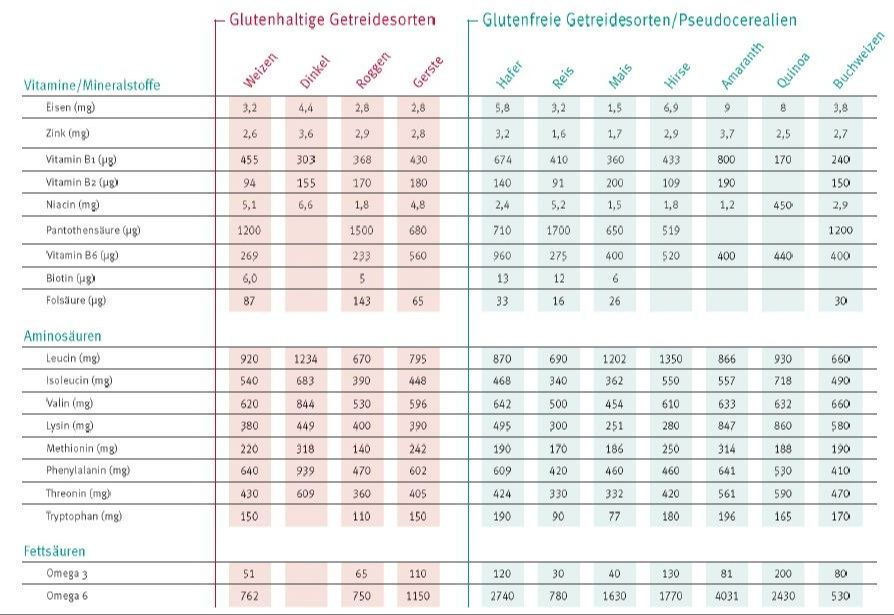
Nutritional comparison of gluten-containing and gluten-free cereals and pseudocereals.
Optimising sensory properties, structure and nutritional physiology
Glutenin and gliadin are two gluten proteins found in wheat grains that form the basis of gluten: they make traditional bread dough pliable and ensure a light crumb. Together with starch, these proteins form a gluten network that traps the carbon dioxide produced during yeast fermentation, causing the dough to rise. This network also influences the water absorption and water storage capacity as well as the elasticity of the end product. In order to obtain a gluten-free product that is optimal in terms of taste and structure but also meets nutritional requirements, a sophisticated mixture of coordinated, high-quality ingredients is necessary.
Gluten-free flagship products are a sign of the highest quality
The following flagship products are examples of how careful selection of ingredients can result in high-quality gluten-free products:
You may also be interested in

FODMAP content of foods
Read more: FODMAPs in food
Sources
- Nascimento AB, Fiates GMR et al. Availability, cost and nutritional composition of gluten-free products. Br J Food 2014; 116:1842-52.
- Badiu E, Aprodu I, Banu I. Trends in the development of gluten-free bakery products. Fascicle VI – Food Technol 2014; 38:21-36.
- Stantiall SE, Serventi L. Nutritional and sensory challenges of gluten-free bakery products: a review. International J Food Sci & Nutr 2017; 28:1-10
- Gobetti M, Rizzello CG et al. How sourdough may affect the functional features of leavened baked goods. Food Microbiol 2014; 37: 30-40