

Coeliac disease: global prevalence and new findings from 2026
An international meta-analysis reveals that 1 in 120 people has coeliac disease and that 41% of diagnosed patients do not present any symptoms.
Coeliac disease: one in 120 people are affected and 41% have no symptoms
A new international meta-analysis confirms that coeliac disease is more common than previously thought and remains significantly underdiagnosed. The findings show that a substantial proportion of patients do not present obvious digestive symptoms, creating new challenges for early detection.
Coeliac disease remains a global health issue
Coeliac disease is an autoimmune condition triggered by the ingestion of gluten in genetically predisposed individuals. Although it has traditionally been considered a digestive disorder, we now know that it can affect multiple organs and present in a wide variety of ways.
A recent systematic review and meta-analysis published in Gastroenterology analysed 87 studies conducted in 39 countries, involving more than 394,000 participants from the general population. The findings provide the most up-to-date estimate of the global prevalence of coeliac disease to date.
How many people have coeliac disease worldwide?
The researchers found that:
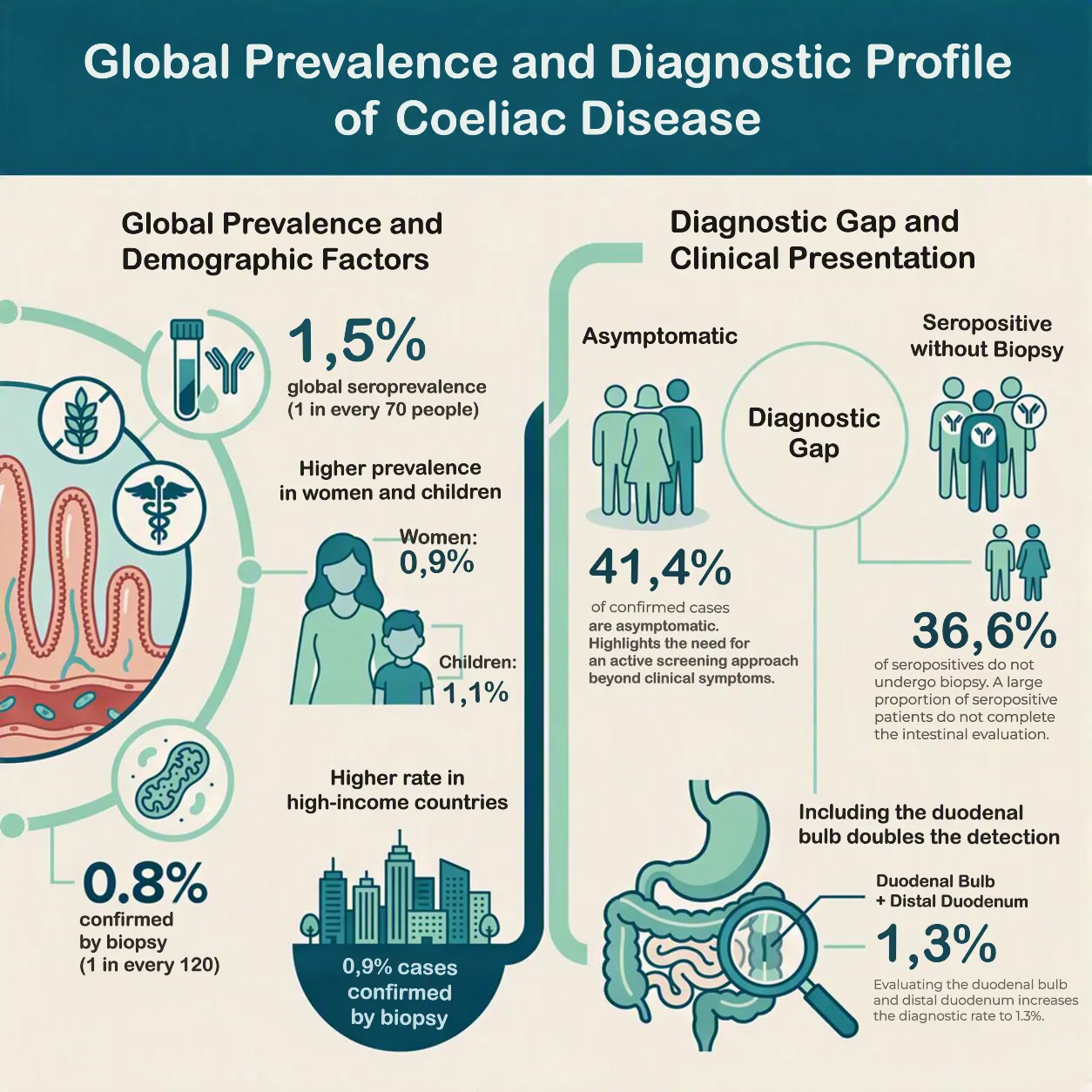
- 1.5% of the global population has positive serology compatible with coeliac disease.
- 0.8% have biopsy-confirmed coeliac disease.
- This corresponds to approximately 1 in 70 people with positive serological markers and 1 in 120 people with a confirmed diagnosis.
These figures are slightly higher than previous estimates and suggest that the true burden of the disease may still be underestimated.

The major challenge: many cases remain undiagnosed
One of the most important findings of the study is the substantial diagnostic gap that continues to exist. Among individuals with positive antibodies:
- 36.6% declined or did not undergo an intestinal biopsy, the procedure required to confirm the diagnosis in most countries.
- In addition, almost one-third of biopsied patients met the criteria for potential coeliac disease, meaning they showed coeliac autoimmunity but did not yet have significant villous atrophy.
According to the authors, these findings suggest that the true prevalence may be even higher than current estimates indicate.
Forty-one per cent of diagnosed patients have no symptoms
Perhaps the most striking finding is that 41.4% of individuals with biopsy-confirmed coeliac disease were completely asymptomatic.
This observation reinforces a reality increasingly recognised by healthcare professionals: coeliac disease does not always cause diarrhoea, weight loss or abdominal pain.
Many people may live with the condition for years without noticeable symptoms while continuing to develop intestinal inflammation and increasing their risk of nutritional and metabolic complications.
More common in women and children
The analysis also identified significant differences according to sex and age.
Symptoms are not always digestive
Among symptomatic patients, the most common gastrointestinal manifestations were:
- Abdominal bloating.
- Flatulence.
- Abdominal pain.
- Diarrhoea.
- Constipation.
However, many patients also presented with extraintestinal symptoms, including:
- Iron deficiency.
- Anaemia.
- Delayed growth or inadequate weight gain.
- Short stature.
- Bone and joint disorders.
- Autoimmune thyroid disease.
These findings demonstrate that clinical suspicion should extend well beyond the classic digestive symptoms.
Are we identifying all cases?
The study also showed that the diagnostic strategy used has a substantial impact on the number of cases detected.
When multiple serological tests were combined rather than relying solely on anti-tissue transglutaminase antibodies (tTG-IgA), detection rates increased by around 40%. Furthermore, in individuals with IgA deficiency, the addition of specific IgG-based tests identified numerous cases that would otherwise have been missed.
Similarly, studies that obtained biopsies from both the duodenal bulb and the distal duodenum detected almost twice as many cases as those that sampled only the distal duodenum.
Implications for clinical practice
The findings of this study underline the fact that coeliac disease remains underdiagnosed worldwide. The high proportion of asymptomatic patients confirms that relying solely on symptoms for diagnosis may leave a large number of affected individuals undetected. To improve detection, the authors highlight the need to:
- Increase awareness of silent forms of the disease.
- Use more comprehensive diagnostic protocols.
- Consider assessment for IgA deficiency.
- Optimise intestinal biopsy strategies.
- Implement appropriate screening programmes for at-risk groups.

Conclusion
The latest evidence confirms that coeliac disease affects at least 1 in 120 people worldwide, although the true prevalence is likely to be higher. Most importantly, four out of every ten diagnosed patients do not experience symptoms, making coeliac disease a significant diagnostic challenge for healthcare professionals.
Improving detection strategies and recognising non-classical presentations will be essential to reducing the large number of cases that currently remain undiagnosed.
You may also be interested in...

Dermatitis herpetiformis: the skin as a sign of coeliac disease
Read more: Dermatitis herpetiformis: the skin as a sign of coeliac disease
3 interesting clinical cases from a nutrition consultation
Read more: 3 interesting clinical cases from a nutrition consultation
Coeliac disease beyond the gut: neurological and psychiatric manifestations
Read more: Coeliac disease: neurological and psychiatric manifestations
Sources
Karimzadehgh S, et al. Global prevalence of celiac disease: a systematic review and meta-analysis. Gastroenterology. 2026.