
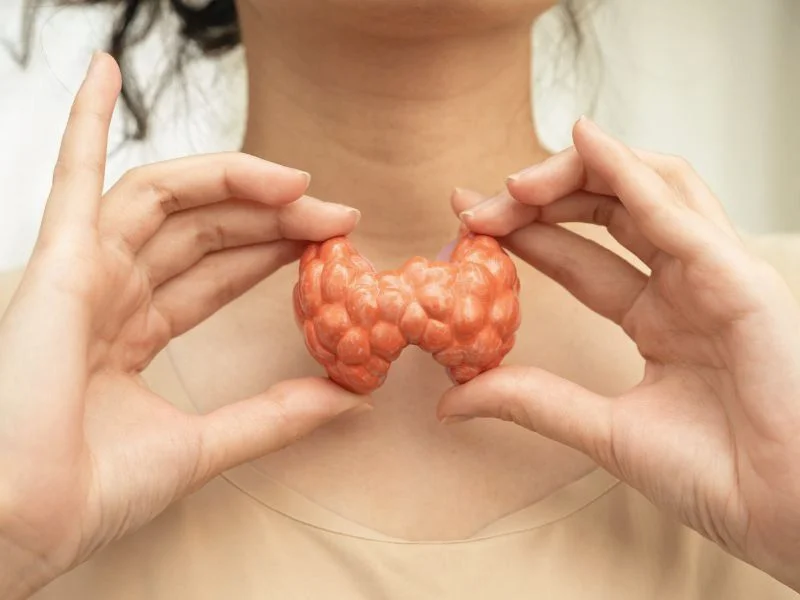
Hypothyroidism and gluten: does a gluten-free diet make sense for Hashimoto’s disease?
Is there a link between gluten and the thyroid? We review the evidence regarding Hashimoto’s disease and explain why you shouldn’t cut out gluten without ruling out coeliac disease.
Hypothyroidism and diet: is it advisable to cut out gluten?
From a clinical perspective, diet in hypothyroidism can raise many questions. In fact, in recent years, the idea that gluten is harmful to the thyroid or even directly responsible for certain thyroid conditions has spread on social media. How much truth is there in these claims?
The reality is that messages of this kind tend to oversimplify a relationship that is more complex from a scientific point of view.
The relevant question is not whether gluten is harmful to the thyroid in general, but rather in which specific patients there might be a link between gluten and the thyroid, and whether a dietary change might play a role in the therapeutic approach.
Gluten and the thyroid: is there a real link or is it just scaremongering?
We have known for years that people with coeliac disease are at greater risk of developing other associated autoimmune diseases. These include certain endocrine disorders, such as type 1 diabetes or specific thyroid conditions. In particular, the link has been most frequently described in autoimmune hypothyroidism, especially in Hashimoto’s thyroiditis.
The coexistence of both conditions is not anecdotal. In fact, some studies have observed a significant prevalence of coeliac disease in patients with autoimmune thyroiditis. A meta-analysis published in the journal Thyroid in 2016 concluded that it may be reasonable to consider screening for coeliac disease in patients with this type of thyroid condition, even in the absence of digestive symptoms.
What is Autoimmune hypothyroidism (Hashimoto’s)?
Hashimoto’s thyroiditis is the most common cause of autoimmune hypothyroidism. It is characterised by progressive destruction of the thyroid gland mediated by the body’s own immune system.
This process involves antibodies that attack structures within the gland, leading to alterations in the production of thyroid hormones and, consequently, changes in parameters such as TSH, T3 or T4.
Autoimmune hypothyroidism cannot be cured, but it can be managed with appropriate treatment and clinical monitoring. The link to diet arises from the observation that some patients with Hashimoto’s disease also exhibit immune reactions to gluten, whether in the context of coeliac disease or non-coeliac gluten sensitivity.

Does a gluten-free diet make sense for non-coeliac Hashimoto’s patients?
Whether it is advisable to remove gluten from the diet of patients with Hashimoto’s disease or autoimmune hypothyroidism without coeliac disease is a frequently asked questions in clinical practice. There is no definitive answer. At present, there is no recommendation to suggest that all people with Hashimoto’s disease should follow a gluten-free diet.
What the available evidence says
Some recent research suggests that reducing or eliminating gluten could be beneficial for certain patients with autoimmune thyroiditis. In some cases, clinical improvement or even a reduction in the required dose of thyroid medication has been observed. However, it is important to note that several of these studies refer more to low-gluten diets, rather than a complete exclusion of gluten. Therefore, although diet may be a potential therapeutic tool, its suitability must always be assessed on an individual basis.
What could be the cause of the link between gluten and the thyroid?
One of the most widely discussed hypotheses regarding the link between the thyroid and gluten is of an immunological nature.
Immunological hypothesis: antibodies and cross-reactivity
In people who react to gluten, the body produces antibodies directed against it’s own cells. These include antibodies against tissue transglutaminase (tTG-IgA). It has been suggested that some of these antibodies may also target thyroid cells due to structural similarities. This cross-reaction phenomenon could contribute to progressive damage to the gland in predisposed patients. If this hypothesis is confirmed in each individual case, reducing exposure to gluten could decrease the production of these antibodies and help preserve thyroid function. However, it is important to note that this is not necessarily the only possible explanation, nor does it occur in all patients.
Thyroid medication in patients with coeliac disease: points to consider
Another relevant aspect of the relationship between gluten and the thyroid relates to the absorption of thyroid medication.
Intestinal absorption and dose adjustment
When a person with undiagnosed coeliac disease has intestinal damage, the absorption of certain drugs may be impaired. In such cases, patients may require higher doses of thyroid medication to achieve the same therapeutic effect. Once coeliac disease has been diagnosed and a gluten-free diet has been started, the intestinal epithelium can gradually recover. As a result, drug absorption improves and it may be necessary to reduce the dose. This phenomenon may coincide with the apparent clinical improvement observed in some patients when gluten is eliminated.
Practical recommendation for clinical practice
In clinical practice, the approach should be cautious and avoid hasty decisions.
Why not all thyroid conditions are related to gluten
In conclusion, a link between gluten and the thyroid does exist, but it should not be interpreted simplistically. Not all people with hypothyroidism benefit from eliminating gluten from their diet, nor are all thyroid conditions related to it. In patients with autoimmune thyroiditis and suspected coeliac disease, it makes sense to consider this approach following robust testing. However, outside these contexts, generalising the elimination of gluten as a universal recommendation for thyroid health is not justified.
You may also be interested in...

Coeliac disease: global prevalence and new findings from 2026
Read more: Coeliac disease: global prevalence and new findings from 2026
Dermatitis herpetiformis: the skin as a sign of coeliac disease
Read more: Dermatitis herpetiformis: the skin as a sign of coeliac disease
3 interesting clinical cases from a nutrition consultation
Read more: 3 interesting clinical cases from a nutrition consultation
Sources
Dietitian-Nutritionist