

Coeliac Disease and Mental Health: The GLOW Framework
New UK research shows living gluten-free is ongoing psychological work. Discover the co-designed GLOW framework for coeliac disease support.
Coeliac Disease and Mental Health: Why Living Gluten-Free Is More Than a Diet
A strict gluten-free diet is the only treatment for coeliac disease. Most coeliac care focuses on dietary advice and healing the gut. But new UK research shows that the mental and emotional side of living gluten-free often gets overlooked.
Researchers worked with patients and healthcare professionals to create GLOW (Gluten-free Living: Optimised Wellbeing). It's a new framework that brings dietary, behavioural and psychological support together.
Why coeliac disease affects mental wellbeing
Coeliac disease affects at least 1 in 100 people worldwide. Managing it means constantly checking ingredients, how food is prepared and what's on offer when eating out. Inconsistent labelling and poor awareness in restaurants and cafés make this harder. So does the common belief that gluten-free is a lifestyle choice rather than a medical treatment.
The emotional toll is well documented. One meta-analysis found that adults with coeliac disease had more than twice the risk of depression, and up to six times the risk of anxiety, compared with the general population. Yet current guidance offers little on how to address these needs in routine care.
Key findings: three challenges of living gluten-free
1. Inconsistent care leaves people working it out alone
Experiences of diagnosis varied widely. Some people got clear explanations and a quick referral to a dietitian. Others were left to search online for answers. Many were surprised to learn that others had received follow-up care they never had. To fill the gaps, people turned to social media and online groups. These offered support but sometimes spread misinformation. Healthcare professionals also said they lacked shared guidance on how strict to be in their advice and where to refer people who were struggling emotionally.
2. Coeliac disease reshapes identity
Food is closely tied to culture, family and belonging. Participants described the ongoing work of adapting traditions and social life to stay safe without losing a sense of who they are. Being seen as "fussy" or following a trend was a common experience. This made some people reluctant to ask whether food was safe, and led some to avoid social eating. Life changes such as starting university, travelling, dating or getting older often unsettled confidence all over again.
3. Living gluten-free is ongoing psychological work
Reading labels, planning ahead and constantly weighing up risk was described as exhausting. Distress was common but often hidden. Many people weren't sure their struggles "counted" enough to raise in appointments. The researchers also noted a pattern like the burnout seen in diabetes: exhaustion from constant vigilance, even in people who were knowledgeable and motivated.
The GLOW framework: three areas of support
GLOW sets out what support needs to achieve, rather than which professional should provide it. This means it can be delivered in healthcare, community, digital and charity settings. It's designed so people can come back for support whenever their needs change.
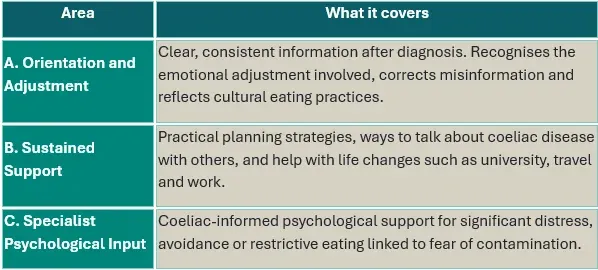
Importantly, the researchers say most needs could be met through short, validating conversations in routine appointments. Specialist mental health care should be kept for persistent distress.
What this means for coeliac care
GLOW's main contribution is a shift in thinking: gluten-free diet management is ongoing psychological work, not a one-off education task. Putting it into practice would mean:
- building psychological skills within existing services
- clearer referral routes
- culturally relevant resources
- tools to help people through predictable life changes
The next step is to test how GLOW works in practice and what resources it needs.
Frequently asked questions
You may also be interested in...
IgA Deficiency and Coeliac Disease: What’s the connection?
Read more: IgA Deficiency and Coeliac Disease: What’s the connection?
chär Cornflakes: 50% Less Salt, Same Great Taste
Read more: Schär Cornflakes: 50% Less Salt, Same Great Taste
Featured products: know better to recommend better
Read more: Flagship products
Sources
Satherley R-M, Hollyfield S, Shahab A, et al. Developing Glow: A Co-Designed Support Framework Integrating Behavioural and Psychological Needs in Coeliac Disease. Health Expectations. 2026;29:e70905. https://doi.org/10.1111/hex.70905