
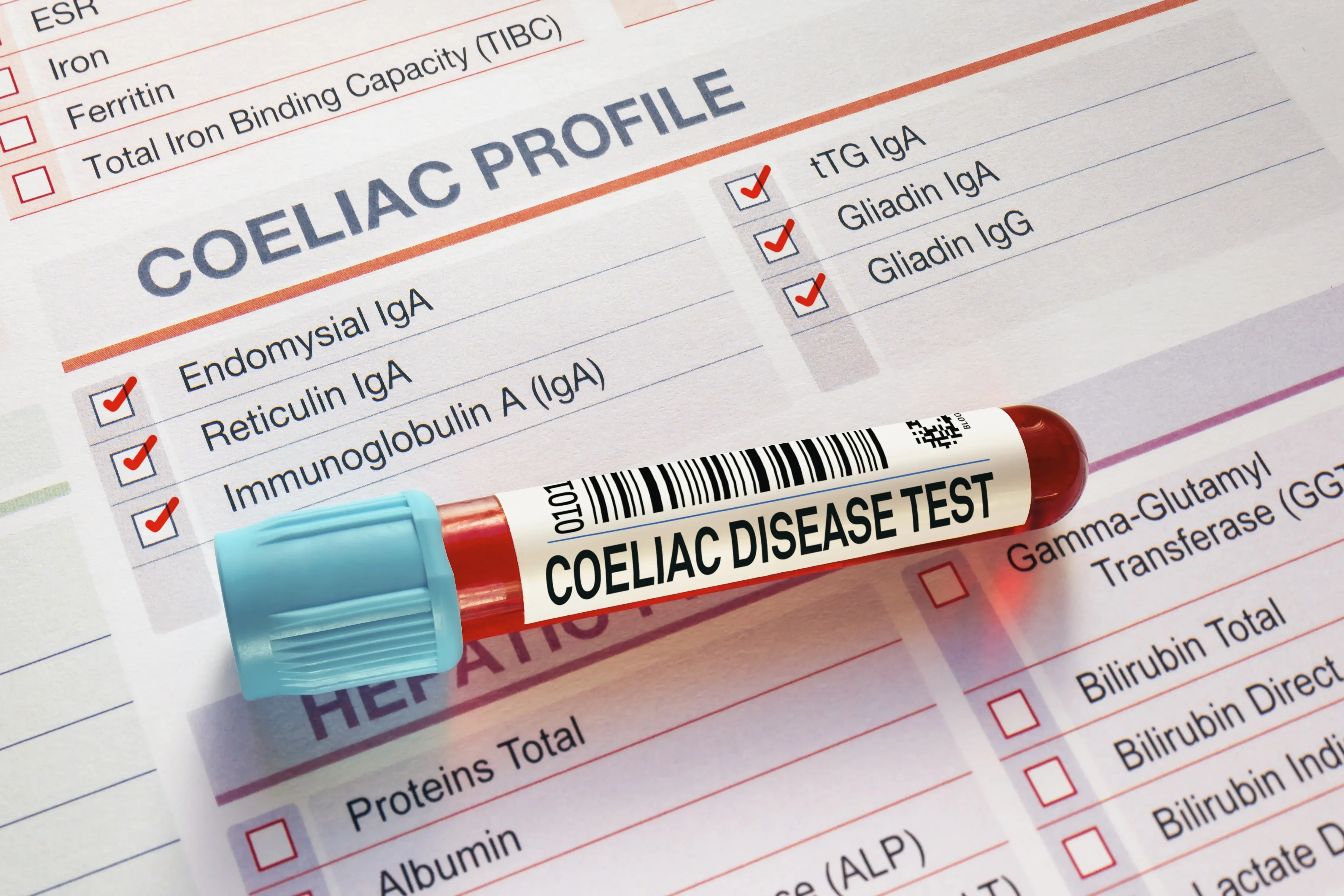
IgA Deficiency and Coeliac Disease: What’s the connection?
Explore the link between IgA deficiency and coeliac disease, including prevalence, diagnosis, IgG-based testing and implications for follow-up care.
IgA deficiency and coeliac disease: what does the latest evidence tell us?
Coeliac disease and selective immunoglobulin A deficiency (IgAD) are closely linked. Importantly, IgA deficiency can also make diagnosing coeliac disease more challenging because commonly used coeliac disease blood tests rely on IgA antibodies.
A 2026 scoping review published in the United European Gastroenterology Journal brings together evidence on the prevalence, clinical features, diagnosis and follow-up of people affected by both conditions. The review included 31 studies published between 1985 and 2024.
What is IgA deficiency?
Immunoglobulin A (IgA) is an antibody with an important role in protecting mucosal surfaces, including those in the gastrointestinal tract. Selective IgA deficiency is defined in the review as a serum IgA level below 0.07 g/L, with normal IgM and IgG levels in people over four years of age. Many people with IgA deficiency are asymptomatic, although it is associated with an increased risk of infections, allergies and autoimmune conditions.
What is the link between IgA deficiency and coeliac disease?
The association works in both directions. Across the studies included in the review:
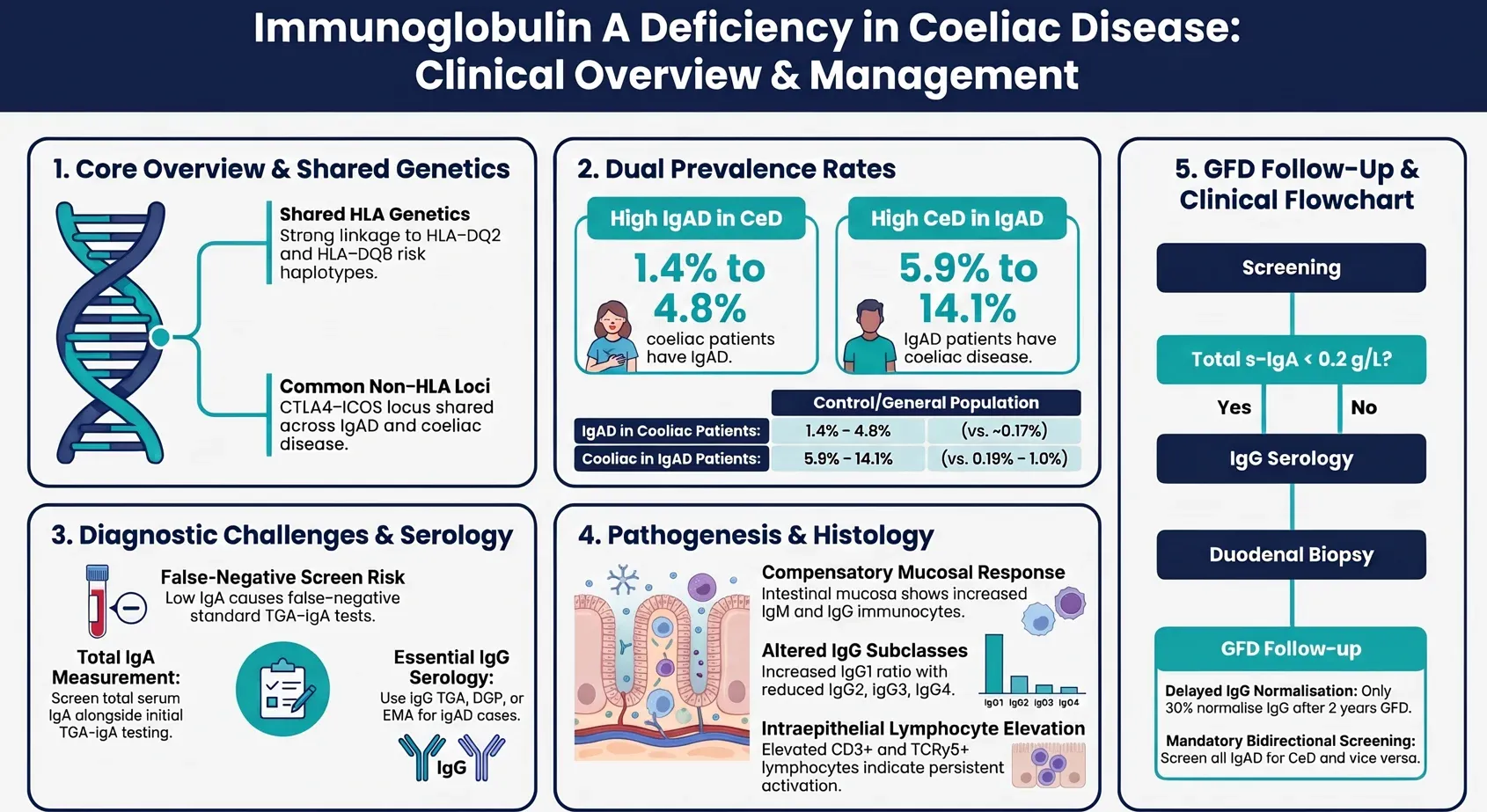
- 1.4-4.8% of people with coeliac disease had IgA deficiency
- 5.9-14.1% of people with IgA deficiency had coeliac disease.
One large study involving 2,100 people with IgA deficiency found coeliac disease in 6.7%, compared with 0.19% of 18,653 controls. The two conditions also share aspects of their genetic background, particularly within the HLA region. However, the review concludes that the mechanisms underlying their association are still not fully understood.
Why does IgA deficiency matter when testing for coeliac disease?
This is arguably the most clinically important finding.
Tissue transglutaminase IgA antibodies (TGA-IgA) are an important biomarker for coeliac disease. However, in someone with IgA deficiency, an IgA-based test may be negative despite the individual having coeliac disease.
The review therefore highlights the importance of identifying IgA deficiency as part of the diagnostic work-up.
When IgA deficiency is present, IgG-based serology can be used, including:
- IgG tissue transglutaminase antibodies (TGA-IgG)
- IgG deamidated gliadin peptide antibodies (DGP-IgG)
- IgG endomysial antibodies (EMA-IgG).
The authors conclude that people with IgA deficiency should be screened for coeliac disease, even if they do not have symptoms.

Do people with IgA deficiency experience different coeliac disease symptoms?
The studies produced mixed findings, but overall the review found that most people with both conditions experienced gastrointestinal symptoms. Reported symptoms included:
- diarrhoea
- abdominal pain and distension
- weight loss
- iron deficiency
- growth failure or short stature in children.
However, the authors highlight the possibility of selection bias because many of the included studies involved hospital populations rather than unselected populations. People with both conditions may also be asymptomatic.
What does IgA deficiency mean for coeliac disease follow-up?
IgG antibodies can be valuable diagnostically, but using them to monitor someone after starting a gluten-free diet is more complicated.
The review found that IgG antibodies can take considerably longer to decline. In one included study, most patients with IgA deficiency remained antibody-positive even after more than two to three years on a gluten-free diet.
Another study reported slower TGA-IgG normalisation in people with IgA deficiency than TGA-IgA normalisation in IgA-competent patients. The review therefore concludes that more research is required to establish the best approach to monitoring people who have both coeliac disease and IgA deficiency.
IgA deficiency and other autoimmune conditions
The relationship may extend beyond coeliac disease.
The review identified evidence that people with IgA deficiency may have an increased prevalence of other autoimmune diseases. It suggests that follow-up of people with coeliac disease and IgA deficiency may therefore include consideration of concomitant autoimmune conditions.
What does this mean for healthcare professionals?
The review reinforces several important considerations:
1. Be aware of IgA deficiency when testing for coeliac disease
IgA deficiency can lead to negative TGA-IgA results, making it an important consideration when interpreting coeliac serology.
2. Use appropriate IgG-based testing when IgA deficiency is identified
The review identifies TGA-IgG, DGP-IgG and EMA-IgG as relevant IgG-based tests.
3. Remember that symptoms are not essential
The authors recommend screening people with IgA deficiency for coeliac disease regardless of whether gastrointestinal symptoms are present.
4. Interpret follow-up serology carefully
IgG antibodies may decline slowly after starting a gluten-free diet, which limits their usefulness as a straightforward marker of dietary adherence.
Key takeaways
- IgA deficiency and coeliac disease occur together more frequently than would be expected in the general population.
- IgA deficiency can complicate coeliac disease diagnosis because IgA-based serological tests may be negative.
- IgG-based coeliac serology is important when IgA deficiency is present.
- People with both conditions may have gastrointestinal symptoms or may be asymptomatic.
- IgG antibodies can remain positive for a prolonged period after starting a gluten-free diet, making follow-up more challenging.
You may also be interested in...

Coeliac Disease and Mental Health: The GLOW Framework
Read more: Coeliac Disease and Mental Health: The GLOW Framework
chär Cornflakes: 50% Less Salt, Same Great Taste
Read more: Schär Cornflakes: 50% Less Salt, Same Great Taste
Featured products: know better to recommend better
Read more: Flagship products
Sources
Bech K, Crawley C, Choung RS, Murray JA, Husby S. Immunoglobulin A Deficiency in Coeliac Disease: A Scoping Review. United European Gastroenterology Journal. 2026;14:e70296.