

Gluten Cross-Contamination: From Real-World Data to Risk-Calibrated Counseling
A scoping review quantifies gluten cross-contamination: 20% of samples exceed 20 ppm, but critical levels are uncommon. How to tailor counseling according to real risk.
Gluten Cross-Contamination: From Real-World Data to Risk-Calibrated Counseling
A gluten-free diet (GFD) is the only treatment for coeliac disease, but its day-to-day management requires constant monitoring of foods and labels, not only to exclude gluten-containing cereals but also to prevent cross-contamination.
Guidelines set 10 mg per day as the maximum tolerable amount of gluten, but quantifying actual exposure resulting from cross-contamination is not straightforward. A recent scoping review published in Clinical Nutrition ESPEN gathered studies analysing nearly 28,000 food samples to assess the true magnitude of cross-contamination.
The authors' message is twofold: cross-contamination remains a key aspect of gluten-free diet management, but it should be addressed gradually and through risk assessment rather than a binary approach. This has direct implications for nutrition counseling and the prevention of hypervigilance.
Cross-contamination in analysed products: the numbers
The review included 59 studies conducted between 1993 and 2024 across 28 countries, covering 27,806 samples of cereal-based products (flour, pasta and bread), snacks, bakery products, oats, rice and quinoa, analysed mainly using ELISA methods.
After excluding two studies with potential methodological and sampling bias, the analysis of 15,467 products showed that 20% of samples exceeded 20 ppm gluten (approximately 3,100 samples), while only 0.9% exceeded 200 ppm.
However, the authors recommend interpreting these figures with caution. The 20% refers to samples selected because they were suspected of contamination and does not represent an estimate of actual exposure among people with coeliac disease.
risk map: where cross-contamination matters and where it does not
The strongest differentiating factor remains gluten-free certification. Certified products show cross-contamination rates ranging from 0.5% to 10%, compared with 10% to 88% among products manufactured outside specific gluten-free food safety standards.
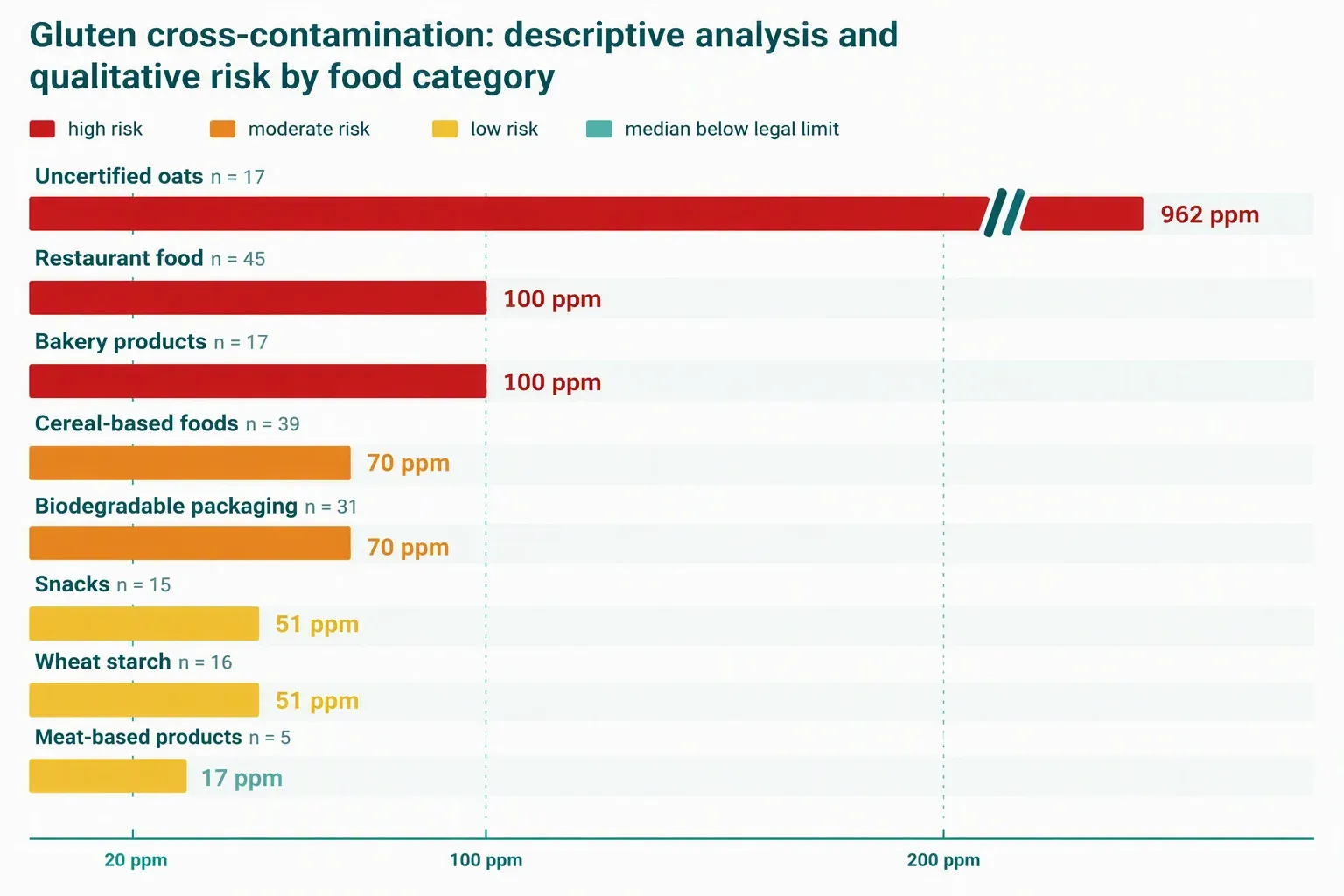
Figure 1. Risk of gluten cross-contamination by food category: median values in ppm and qualitative risk classification. The bar corresponding to uncertified oats is off the scale. Adapted from Studerus et al., 2026 (2).
Household practices: what the data show
According to the review authors, several restrictions commonly considered essential are not supported by available evidence.
Shared household utensils consistently produced values below 20 ppm, and all cleaning methods tested proved effective in removing residual gluten.
Similarly, use of a shared toaster remained below the established threshold, with only a single sample reaching 21.5 ppm.
from data to counseling: adjust without letting down your guard
The authors translate the evidence into four practical recommendations:
- Recommend only certified gluten-free cereals and oats.
- Explicitly request gluten-free restaurant options.
- Distinguish dedicated gluten-free bakeries from conventional bakeries.
- Avoid unsupported restrictions when evidence indicates low risk.
Conclusion
The review proposes a new classification based on the qualitative risk of cross-contamination. Although about 20% of analysed samples exceed 20 ppm, the highest levels are concentrated within a limited number of categories. The authors recommend focusing efforts on truly critical categories, prioritising certified gluten-free products and reducing restrictions that lack scientific support.
You may also be interested in...

Coeliac disease: global prevalence and new findings from 2026
Read more: Coeliac disease: global prevalence and new findings from 2026
Dermatitis herpetiformis: the skin as a sign of coeliac disease
Read more: Dermatitis herpetiformis: the skin as a sign of coeliac disease
3 interesting clinical cases from a nutrition consultation
Read more: 3 interesting clinical cases from a nutrition consultation
Sources
- Al-Toma, A., Branchi, F., Zingone, et al. (2026). European Society for the Study of Coeliac Disease (ESsCD) 2025 Updated Guidelines on the Diagnosis and Management of Coeliac Disease in Adults. Part 2: Management, Follow-Up, and Complex Disease Courses. United European gastroenterology journal, 14(2), e70195.
- Studerus D, Lee AR, Hugo T, Heim P, Jossen J, Scharl M, et al. Understanding cross-contamination in a gluten-free diet: a scoping review. Clin Nutr ESPEN. 2026;71:102847.
- Zandonadi RP, Romão B. Gluten-free diet in the context of food and nutrition security, food safety, and sustainability. Nutr Rev. 2026;84(4):839-50.