

FODMAP Manipulation for Exercise-Associated GI Symptoms: A Severity-Led Approach
New research argues low-FODMAP diets should be used strategically, not routinely, for athletes with exercise-associated gastrointestinal symptoms. Here's what HCPs need to know.
Why Symptom Severity Should Guide FODMAP Manipulation in Endurance Athletes
A new Current Opinion article published in Sports Medicine challenges the growing tendency for endurance athletes to adopt low-FODMAP diets as a default. Instead, the authors make an evidence-based case for a strategic, symptom-severity-led approach.
The clinical problem: Ex-GIS and EIGS
Exercise-associated gastrointestinal symptoms (Ex-GIS) - flatulence, lower-abdominal bloating and pain, nausea, and urge to defecate - are reported by up to 80% of ultra-endurance runners and can interrupt training and compromise race-day execution. These symptoms are an outcome of exercise-induced gastrointestinal syndrome (EIGS), the pathophysiological response of the gut to exercise. EIGS develops primarily via two pathways:
Substantial GI integrity changes are typically only seen with ≥2 hours of exertional-heat stress or ≥3 hours in temperate conditions - below this threshold, clinically relevant changes are unlikely.

Why athletes turn to FODMAPs
Because Ex-GIS closely mirrors the symptoms of irritable bowel syndrome (IBS) - where low-FODMAP diets have proven efficacy - many athletes self-experiment with FODMAP restriction. The most commonly eliminated components are lactose (88%), fructose (24%), galacto-oligosaccharides (22%), polyols (6%) and fructo-oligosaccharides (5%), with nearly all athletes reporting symptom improvement after removal.
The central argument: a two-sided coin
The authors reviewed six experimental studies applying low-FODMAP interventions in endurance athletes. Their position rests on an apparent paradox:
1. Low-FODMAP reduces symptom severity (short-term)
In most trials, low-FODMAP diets were associated with less gut discomfort and reduced total, upper and lower GI symptom severity. Importantly, this appears to reduce symptom severity rather than incidence - athletes may still experience symptoms, but they tend to be milder.
2. High-FODMAP may protect gut integrity
FODMAPs act as prebiotics, driving short-chain fatty acid (SCFA) production that may stimulate epithelial microvascular blood flow and mitigate intestinal injury. In one trial, a high-FODMAP diet increased total faecal SCFA by ~60%. This suggests higher intakes could help protect the gut lining during prolonged strenuous exercise - though at the cost of greater malabsorption and potentially more symptoms.
3. No consistent performance benefit
Only one controlled trial examined performance. Despite greater symptom severity on the high-FODMAP trial, there was no significant difference in distance performance. The authors caution against promoting low-FODMAP diets as performance-enhancing in their own right - any gains are likely secondary to better symptom control.
What this means for practice
The authors recommend that FODMAP manipulation be viewed as one component of a broader, individualised GI management plan, not a universal prescription:
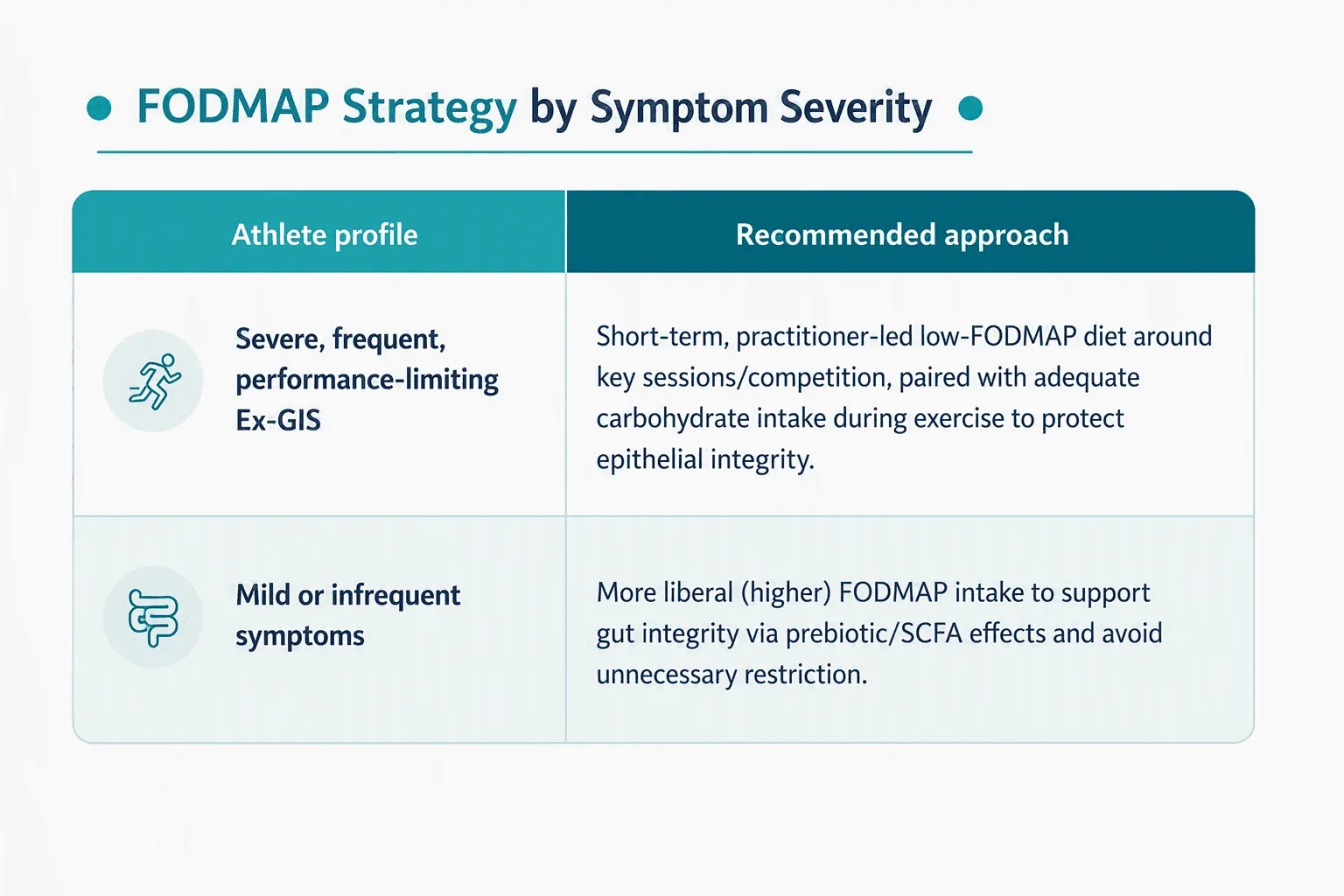
Two practical cautions stand out for dietitians/ nutritionists:
- Adequate carbohydrate provision matters. Higher carbohydrate intake (e.g. 45 g·h⁻¹) during exercise can itself ameliorate epithelial injury, sometimes independently of FODMAP content.
- Guard against disordered eating. Low-FODMAP diets should not become a chronic default, particularly in athletes with restrictive eating patterns. Restriction should be time-limited, symptom-driven, and delivered with expert nutrition support and monitoring.
The bottom line
FODMAP manipulation is a useful but nuanced tool for managing Ex-GIS. Current evidence - drawn from a small number of well-controlled trials - supports short-term (24-48 h) low-FODMAP diets to reduce symptom severity in athletes with significant symptoms, while higher-FODMAP intakes may better support gut integrity when symptoms are mild. Any modification should be individualised and guided by likely causal mechanisms, symptom severity, exercise demands, and overall dietary adequacy.
You may be also interested in...

Coeliac disease: global prevalence and new findings from 2026
Read more: Coeliac disease: global prevalence and new findings from 2026
Dermatitis herpetiformis: the skin as a sign of coeliac disease
Read more: Dermatitis herpetiformis: the skin as a sign of coeliac disease
3 interesting clinical cases from a nutrition consultation
Read more: 3 interesting clinical cases from a nutrition consultation
Sources
Scrivin R, Daniel NVS, Slater G, Costa RJS. Dietary FODMAP Manipulation for Exercise-Associated Gastrointestinal Symptoms: Why Symptom Severity Should Guide Our Approach. Sports Medicine. 2026. https://doi.org/10.1007/s40279-026-02474-9