
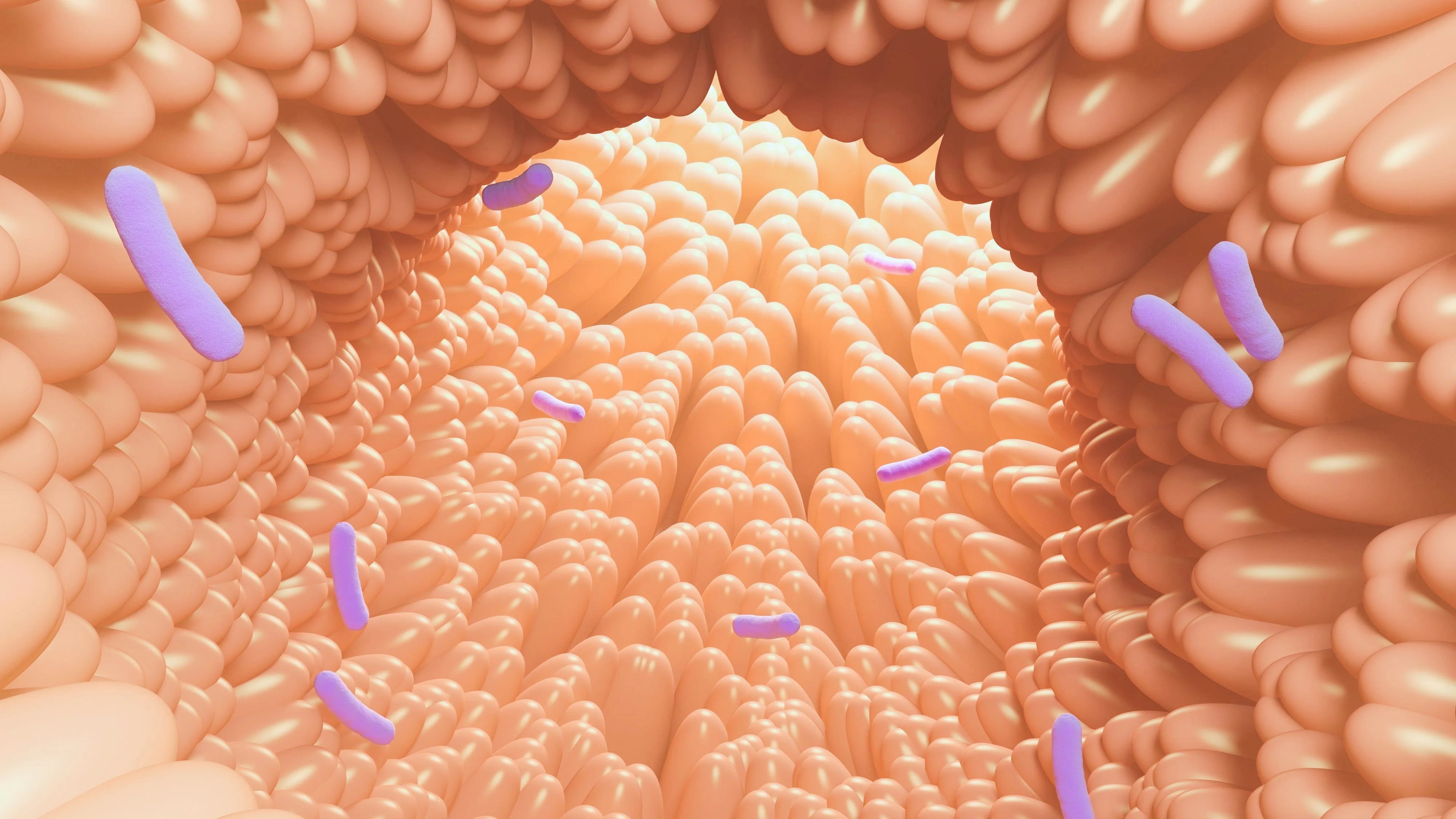
Coeliac disease and gut microbiota: new genetic evidence
New scientific evidence shows how the gut microbiota, in interaction with genetics, can modulate the risk of coeliac disease.
Coeliac disease: new evidence on the role of the gut microbiota
A large-scale genetic study reveals how human DNA influences the composition of the gut microbiota and identifies a microbial species associated with a lower risk of coeliac disease.
Coeliac disease is an autoimmune condition that develops in response to the ingestion of gluten in genetically predisposed individuals, causing damage to the mucosa and the small intestine. Although the role of HLA genes in susceptibility to the disease is well known, only a proportion of predisposed individuals develop the condition, suggesting the involvement of additional environmental and biological factors.
Among these, the gut microbiota is emerging as a possible modulator of disease risk, due to its ability to influence the immune response intestinal barrier function.
A population study in Northern Europe
A large population-based study published in February 2026 in Nature Genetics analysed the interaction between individual genetic profiles and gut microbiota composition, assessing their association with coeliac disease.
The research involved over 12,000 Norwegian adults, with subsequent validation of the results in independent Swedish and Finnish cohorts. Participants underwent genetic analysis and microbiome studies using faecal samples, enabling an integrated assessment of human genetics and the gut environment.
Genetic variants and microbiota composition
The results indicate that specific genetic variants significantly influence the composition and function of the gut microbiota. In particular, variants of the lactase gene, associated with lactose intolerance, are correlated with differences in the presence of bacteria such as Bifidobacterium. This demonstrates how genetics can modulate the gut ecosystem, including through nutrient metabolism.
Overall, the study identified 106 genetic signals associated with microbiota composition, of which 13 were located at 7 different statistically significant loci.
A bacterial species associated with a lower risk of coeliac disease
A particularly significant finding concerns the identification of a bacterial species, Agathobacter sp., associated with a lower risk of coeliac disease. Higher levels of this microorganism are correlated with a lower prevalence of the condition.
However, the nature of the association is not yet fully understood. It is possible that the presence of the bacterium exerts a protective effect, but it cannot be ruled out that it is coeliac disease itself that causes a reduction in the gut microbiota.
The study also highlights that it is not only the presence of specific bacterial species that matters, but also their metabolic activity, which can influence the immune response and inflammatory processes in the gut.
New prospects for prevention and treatment
Overall, these findings highlight the complex interaction between genetics and the gut microbiota in the pathogenesis of coeliac disease. Although a strictly gluten-free diet is currently the only effective treatment, this new evidence opens up avenues for research aimed at future preventive and therapeutic strategies based on the modulation of the gut microbiota.
You may also be interested in...

Coeliac disease: global prevalence and new findings from 2026
Read more: Coeliac disease: global prevalence and new findings from 2026
Dermatitis herpetiformis: the skin as a sign of coeliac disease
Read more: Dermatitis herpetiformis: the skin as a sign of coeliac disease
3 interesting clinical cases from a nutrition consultation
Read more: 3 interesting clinical cases from a nutrition consultation
Sources
Moksnes, M. R., Coward, E., Nethander, M., Dekkers, K., Grahnemo, L., Törnqvist, A. E., Li, L., Lundmark, P., Pertiwi, K., Baldanzi, G., Mjelle, R., Moll, J. M., Eklund, A. C., Nielsen, H. B., Svensson, J., Langhammer, A., Giskeødegård, G. F., Brumpton, B., Hjort, R., Ness-Jensen, E., Engström, G., Pelaseyed, T., Michaëlsson, K., Orho-Melander, M., … Ohlsson, C. (2026). The HUNT study identifies host genetic factors reproducibly associated with human gut microbiota composition. Nature Genetics, 58, 530-539. https://doi.org/10.1038/s41588-026-02502-4